
Understanding Ross School Funding: Part 1 of 7
Who pays for our schools? Understanding the state and local shares
When property values rise, homeowners may see a change in their tax bills. Those same property values also influence how Ohio determines the state’s share of school funding.
For Ross Local Schools, that calculation has shifted significantly: the state’s calculated share of base education costs has decreased, while the share assigned to local resources has increased.
Today, we’re beginning a seven-part weekly series to explain how school funding works, what has changed, and what those changes mean for Ross. Our goal is to provide clear information so our community can understand the financial decisions ahead.
How does the state determine its share?
Ohio’s school funding formula divides the calculated cost of providing a basic education between state and local resources. To determine that division, the formula considers a district’s property values and residents’ income as measures of its ability to raise money locally.
As property values increase, the formula can calculate that a community has greater capacity to fund its schools. That can result in a smaller calculated state contribution and a larger local share.
But a higher home value does not necessarily mean a larger paycheck or more room in a household budget. The formula measures the community’s estimated ability to raise revenue; it does not measure each family’s ability to afford a higher tax bill.
What has changed for Ross?
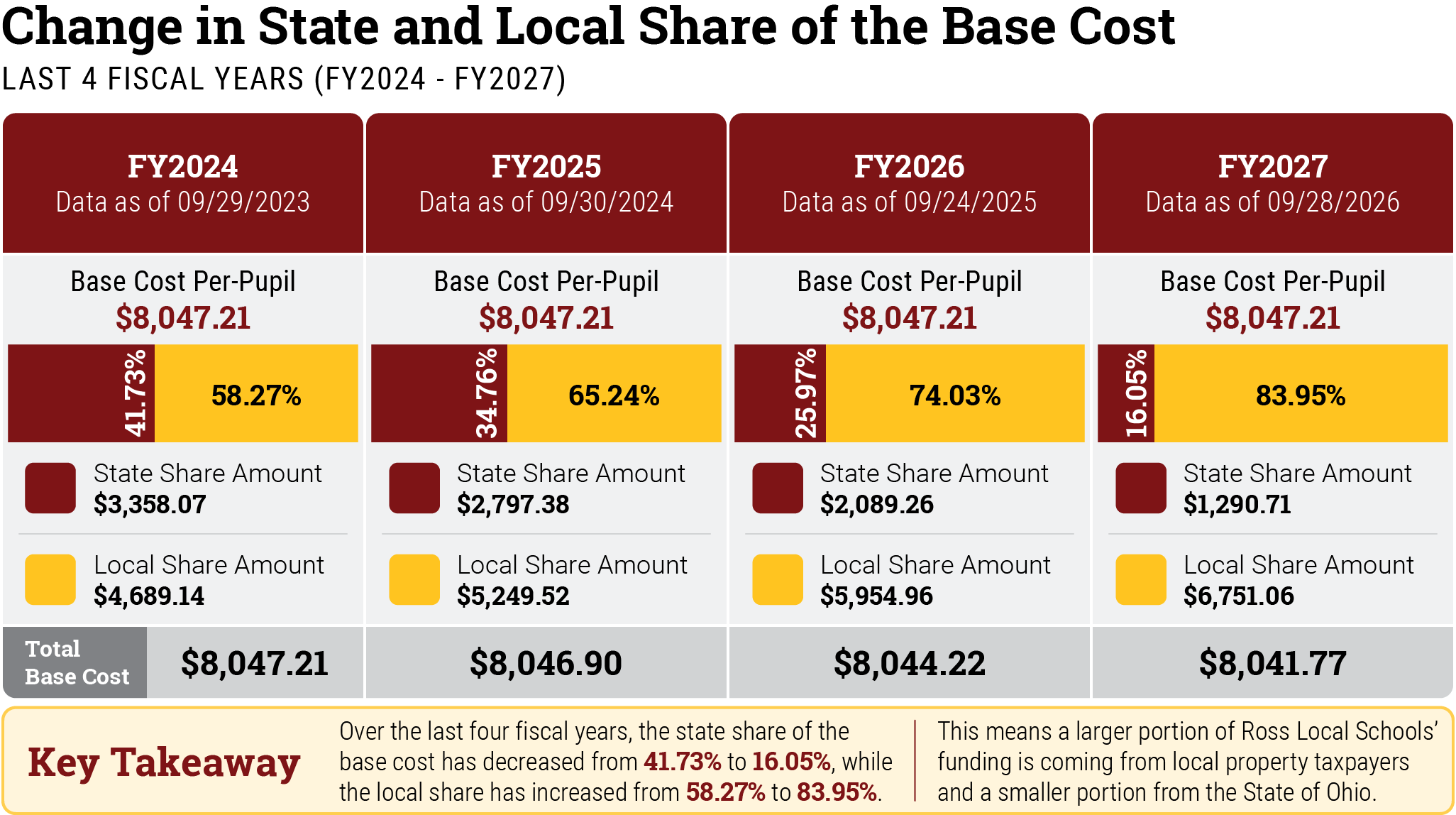
The comparison in our Impact Report shows how the formula’s division of base education costs has changed:
Fiscal year 2024: approximately 42% state share and 58% local share.
Fiscal year 2027: approximately 16% state share and 84% local share.
Think of it this way: for every $100 of calculated base education costs, the formula assigned about $58 to local resources in fiscal year 2024. By fiscal year 2027, that amount had grown to about $84.
Rising property values are one factor in this calculation. Income measures and enrollment also affect how the formula determines a district’s local capacity.
These percentages describe the division of the formula’s base education cost. They do not represent the percentages of Ross’s entire budget paid by the state and local taxpayers, and they do not automatically increase anyone’s taxes.
What does this shift mean for Ross’s financial future?
Ross currently receives state funding through provisions known as funding guarantees. These provisions help maintain funding when the state’s formula would otherwise provide less. They are an important protection for our schools, but they do not ensure that funding keeps pace with rising expenses.
Our August 2026 forecast projects overall state funding to remain flat in future years, even as the costs of operating our schools increase. Meanwhile, the formula assigns a growing share of base education costs to local resources.
Recent state decisions help explain why long-term planning is challenging. Ohio continued the phase-in of the Fair School Funding Plan while retaining fiscal year 2022 salary and cost inputs. In other words, completing the phase-in did not update those inputs to reflect today’s costs. The state also expanded eligibility for private-school tuition scholarships through EdChoice Expansion to families across income levels, with scholarship amounts varying by income.
These decisions demonstrate that the state can change how it distributes education funding from one budget to the next. The funding formula and the guarantees that currently support Ross remain subject to future legislative decisions.
Our concern is what happens if those protections change while the formula continues to assign more responsibility to our community. Rising property values and income measures can lead the state to calculate that Ross has greater capacity to fund its schools locally. That calculation does not necessarily mean families have more room in their budgets—or that the district receives enough additional local revenue to cover its expenses.
If a future state budget reduces the guarantees without providing sufficient funding through the formula, Ross could face a loss of revenue and greater financial pressure. That is a risk we must consider, not a funding reduction we are announcing today.
Our responsibility is to plan using the funding currently available, evaluate what future changes could mean, and keep our community informed. The guarantee matters. So does understanding how much our district depends on decisions made in Columbus.
A community investment worth celebrating
Our community also has a financial milestone approaching. The bonds issued to help build the current Ross High School, which opened in 2005, are scheduled to be paid in full in December 2028.
That is something Ross can be proud of. Residents made a long-term investment in a building that continues to serve students and the wider community through athletic events, performances, student activities, and community gatherings.
When that debt is paid, the property tax collection needed to repay it will end. Those debt payments are separate from the funding used to operate our schools each day. Paying off the building does not create additional operating revenue, but it marks the completion of a commitment our community made together.
Understanding that distinction—and how state and local funding work together—is an important starting point for the conversations ahead.
Next Week: How did Ohio’s school funding system get here? Part Two will explore the changes that have shaped how schools are funded today.